


Nairobi. The decarbonisation of the global buildings and construction sector is slowing, threatening efforts to reduce greenhouse gas emissions and improve affordable housing, according to a new report released by the UN Environment Programme (UNEP) and the Global Alliance for Buildings and Construction (GlobalABC).
The Global Status Report for Buildings and Construction (2025–2026) shows that operational emissions from buildings rose by one percent in 2024 to reach 9.9 gigatonnes of carbon dioxide (GtCO₂), reflecting the growing environmental impact of the sector.
The report warns that although buildings worldwide are becoming more energy efficient, progress remains too slow to meet global climate targets and the goal of achieving net-zero emissions by 2050.
Speaking during the release of the report on May 19, 2026, UNEP Executive Director Inger Andersen said buildings have a direct influence on people’s quality of life and climate resilience.
“From homes and schools to hospitals and workplaces, buildings play a fundamental role in our lives,” she said.
“Buildings can either lock in climate risks or deliver safer, healthier, and more affordable living conditions.”
She noted that with nearly half of the world’s buildings expected to be constructed or renovated by 2050, governments have an opportunity to promote zero-emission and climate-resilient construction through stronger policies, building codes, and investment.
According to the report, the world currently adds about 12.7 million square metres of floor space every day, almost equivalent to building the entire city of Paris every week.
In 2024, global building floor area expanded by 1.7 percent to reach 273 billion square metres, driven largely by rapid urbanisation and construction in emerging economies, including India and Southeast Asia.
The buildings and construction sector now accounts for nearly 50 percent of global material extraction, 37 percent of greenhouse gas emissions, and 28 percent of global energy consumption.
The report notes that since 2015, global building energy intensity has fallen by 8.5 percent, while green building certifications have nearly tripled.
However, renewable energy still supplied only 17.3 percent of buildings’ energy demand in 2024, far below levels required to align with net-zero targets.
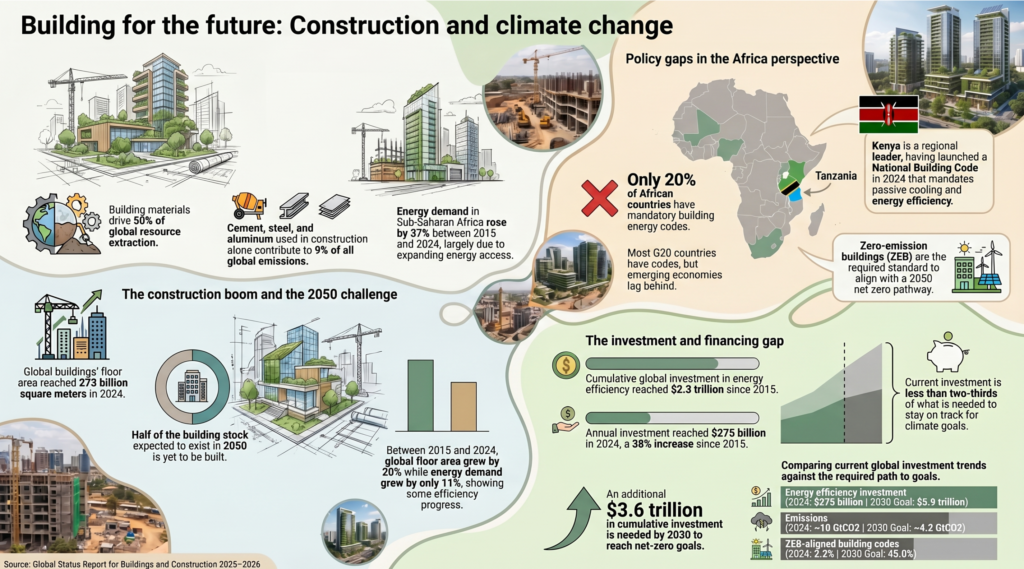
Investment in building energy efficiency reached 275 billion US dollars in 2024, bringing cumulative global investment since 2015 to 2.3 trillion US dollars.
Despite these gains, the report says progress has slowed since 2020 as the pace of sustainable construction has failed to match rapid urban growth and rising housing demand.
To place the sector on a net-zero pathway, UNEP estimates that investment in building energy efficiency must rise to 5.9 trillion US dollars by 2030, equivalent to about 592 billion US dollars annually.
The report highlights several countries and regions making progress in reducing emissions from buildings.
These include the European Union’s efforts to reduce both operational and embodied emissions, improvements in building energy performance in Japan and Switzerland, and increased adoption of on-site renewable energy systems in Australia, Germany, India, and Pakistan.
Other examples include updated building energy codes in California, Kenya, Japan, and Singapore, as well as the expansion of green building certification programmes in China, Colombia, India, and Türkiye.
Countries such as Bangladesh, Ghana, Indonesia, Jordan, and Senegal have also developed national roadmaps to support transformation of the buildings sector.
UNEP and GlobalABC said they would continue supporting countries to strengthen data systems, improve methodologies, and develop policies aimed at accelerating climate action while addressing housing affordability and social equity challenges.