



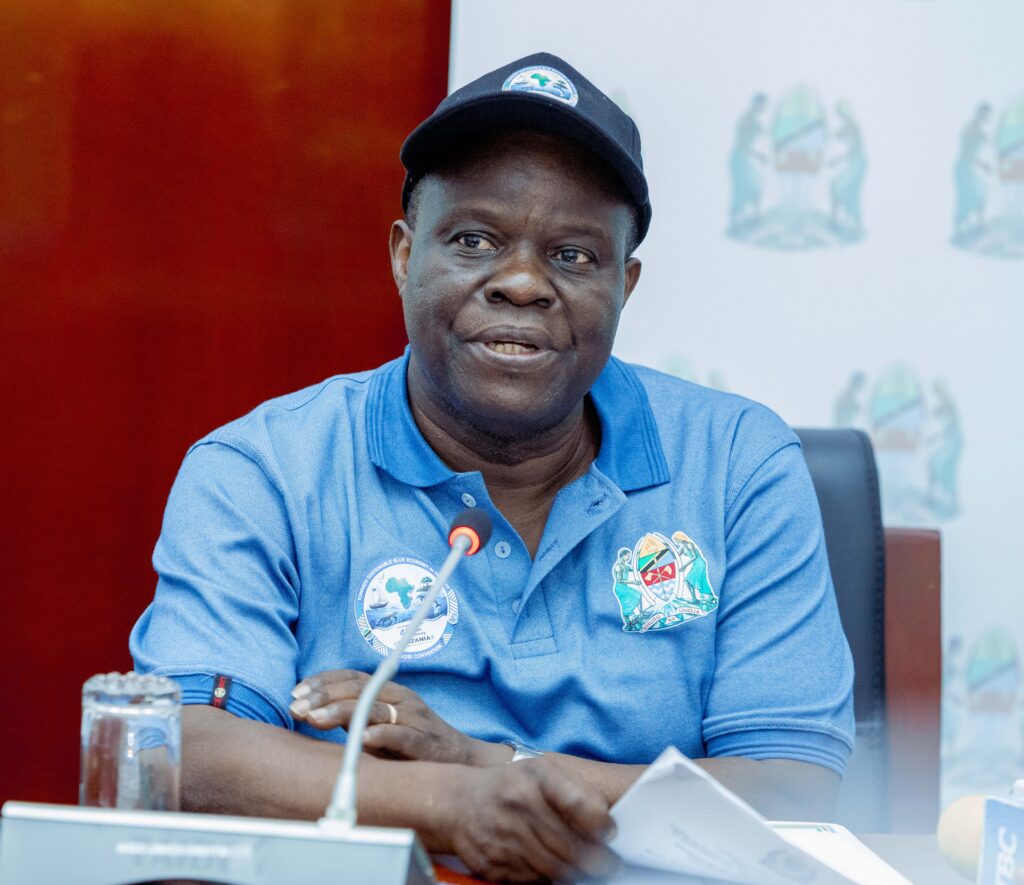
Minister of State in the Vice President’s Office (Union and Environment), Mhandisi Hamad Masauni, addresses journalists during a press conference in Dar es Salaam ahead of the 12th Conference of the Parties to the Nairobi Convention (COP12), scheduled for October 6–10, 2026.
By Habitat Media Reporter
Dar es Salaam. Tanzania is seeking stronger regional cooperation to tackle mounting threats to the Western Indian Ocean as it hosts a major international conference on marine and coastal environmental protection this week.
The 12th Conference of the Parties to the Nairobi Convention (COP12), scheduled for October 6–10 in Dar es Salaam, will bring together governments, researchers, investors and other stakeholders to discuss measures for protecting marine ecosystems while promoting sustainable use of ocean resources.
More than 1,460 delegates have registered for the conference, including more than 700 participants from outside Tanzania. The meeting is expected to be officially opened by President Samia Suluhu Hassan.
Minister of State in the Vice President’s Office (Union and Environment), Mhandisi Hamad Masauni, said countries in the region were facing growing threats from climate change, marine pollution, illegal fishing and degradation of marine ecosystems.
“The challenges of climate change, marine pollution, illegal fishing and ecosystem degradation are affecting most countries in the region. This is why we need to develop strategies and continue raising public awareness so that communities understand the importance of protecting our oceans,” Mr Masauni said.
He said COP12 would provide an opportunity for countries to strengthen joint action on marine resources while ensuring that communities dependent on the ocean benefit from sustainable economic activities.
The conference will focus on the conservation and restoration of critical marine ecosystems, including mangroves, coral reefs and seagrass beds, which provide breeding grounds for fish, protect coastlines and support the livelihoods of coastal communities.
Permanent Secretary in the Vice President’s Office, Richard Muyungi, said protecting marine biodiversity was central to ensuring the long-term sustainability of fisheries and other activities dependent on ocean resources.
The meeting will also consider measures to control pollution from land-based and marine activities, improve the resilience of coastal infrastructure and ecosystems to climate change, and strengthen regional cooperation in managing shared marine resources.
Tanzania’s national theme for COP12 is “Towards a Sustainable Blue Economy in the Western Indian Ocean for People and the Environment.”
According to Mr Masauni, the theme reflects the country’s intention to link environmental protection with economic development and improved livelihoods.
He said sustainable management of marine resources could create opportunities in fisheries, aquaculture, marine tourism, water transport and other blue economy activities.
“We expect investors to discuss and identify various investment opportunities in the blue economy,” he said.
COP12 is also expected to adopt the Dar es Salaam Declaration, decisions of the Conference of the Parties and a Joint Ministerial Declaration. Delegates will also elect the bureau that will lead the Nairobi Convention during the 2026–2028 period.
The conference will further review implementation of key international frameworks, including the Nairobi Convention, United Nations Convention on the Law of the Sea (UNCLOS), Biodiversity Beyond National Jurisdiction (BBNJ) Agreement, Convention on Biological Diversity (CBD), United Nations Framework Convention on Climate Change (UNFCCC) and the International Convention for the Prevention of Pollution from Ships (MARPOL).

Mr Masauni said the meeting would also promote the use of scientific research, technology and marine spatial planning in decision-making.
“Protecting and restoring mangroves, coral reefs and seagrass beds is not only an environmental responsibility; it is also an economic opportunity because these ecosystems support livelihoods and protect coastal communities,” he said.
He urged government institutions, the private sector, academics, researchers, civil society organisations and citizens to participate actively in the conference to ensure its decisions translate into practical action to protect the Western Indian Ocean and improve the livelihoods of coastal communities.