


By Habitat Media Reporter
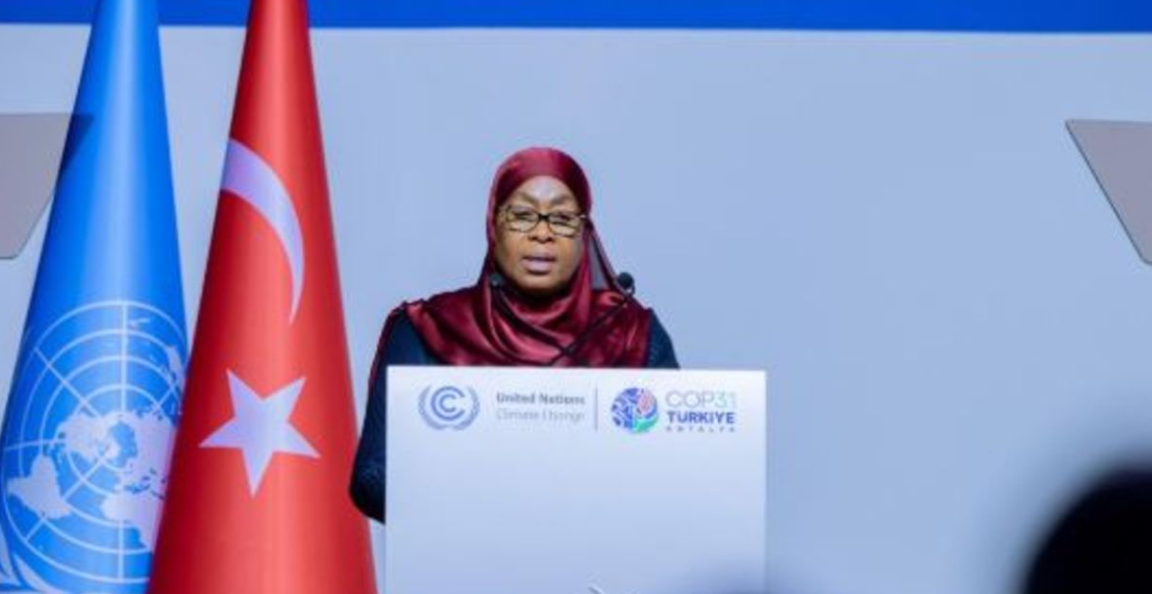
Antalya, Türkiye. Tanzania is seeking increased international climate financing, technology transfer and capacity building, alongside investments in affordable energy and climate-resilient development, as the country steps up efforts to protect its economy from the growing impacts of climate change.
President Samia Suluhu Hassan outlined the three priorities at the 31st United Nations Climate Change Conference (COP31) in Antalya, Türkiye, saying developing countries needed stronger international support to address climate challenges while pursuing their development ambitions.
She said climate-related shocks, including prolonged droughts, unpredictable rainfall patterns and rising sea levels, were estimated to cost Tanzania between two and three per cent of its Gross Domestic Product (GDP) annually.
The President identified climate finance, technology transfer and capacity building; equitable access to affordable energy; and inclusive, climate-resilient development as the three critical areas requiring attention and international cooperation.
On climate finance, President Samia called for increased access to grants and concessional loans, particularly for adaptation programmes, alongside the transfer of appropriate technologies and investment in local skills.
She said climate action should be guided by equity, climate justice and the principle of common but differentiated responsibilities and respective capabilities, recognising that countries have different financial resources and development circumstances.
The President also called for fairer access to international carbon markets under Article 6 of the Paris Agreement, saying Tanzania had considerable potential to generate carbon credits through transport, waste management, renewable energy and forest conservation.
She emphasised the need for transparent carbon market mechanisms that guarantee fair carbon pricing and equitable benefit-sharing, while ensuring environmental sustainability and directing more resources towards local communities and national development.
Tanzania has an estimated 48.1 million hectares of forest, representing about 55 per cent of its total land area, according to the Tanzania Forest Services Agency. The resource presents opportunities for conservation and carbon-related investments.
On energy, President Samia’s call for equitable access to affordable energy comes as Tanzania seeks to expand its clean electricity generation and attract investment in renewable energy infrastructure.
In a related development, the United Kingdom has committed $2 million (about Sh5.3 billion) to support private investment in Tanzania’s renewable energy sector, as part of a wider $6 million package targeting clean power generation and regional electricity trade in Eastern Africa.
Announced at COP31 on November 11, the funding will support improvements to the technical, legal, regulatory and commercial frameworks needed to attract private investment in renewable electricity generation and transmission.
The programme is being implemented in collaboration with the World Bank Group and the Tanzanian Government to create favourable conditions for increased private-sector participation in the country’s clean energy industry.
According to the UK Government, the investment is expected to help Tanzania harness its renewable energy resources, improve electricity reliability and expand access to power for households and businesses.
British High Commissioner to Tanzania Marianne Young said reliable and affordable electricity was fundamental to the country’s economic development.
“By creating the right conditions for private investment, we can help Tanzania make better use of its clean energy resources and build a more resilient power system,” she said.
She said the UK remained committed to supporting Tanzania and its regional partners in developing a more interconnected electricity market capable of attracting investment and supporting businesses.
Of the wider funding package, another $4 million will be channelled through the World Bank Group to strengthen regional electricity trade under the Regional Energy Transmission, Trade and Decarbonisation Programme for Eastern Africa (RETRADE-EA).
The programme seeks to enable participating countries, including Tanzania, to access potentially cheaper electricity from neighbouring markets while strengthening national power systems against supply shortages and climate-related disruptions.
The funding forms part of the UK’s contribution to the Global Clean Power Alliance (GCPA) Finance Mission, a joint initiative with Brazil aimed at mobilising international private financing for clean energy transitions in emerging and developing economies.
The announcement was made during a Finance Mission event at the COP31 UK Pavilion, marking one year since the alliance was launched at COP30 in Brazil.
Tanzania was among the first African countries to join the Global Clean Power Alliance, reflecting its commitment to expanding clean electricity generation.
The Finance Mission brings together governments, investors, multilateral development banks and development partners to identify investment opportunities and mobilise financing for clean energy and electrification projects.
The UK said its continued partnership with Tanzania would focus on strengthening the conditions needed to attract investment, expand renewable energy infrastructure and support a more reliable and sustainable electricity system.