



By Habitat Media Reporter
Dar es Salaam. The Western Indian Ocean holds billions of dollars in economic potential, but limited access to finance, technology and value-addition opportunities is preventing countries in the region from fully turning their marine resources into jobs, businesses and sustainable revenues, stakeholders have said.
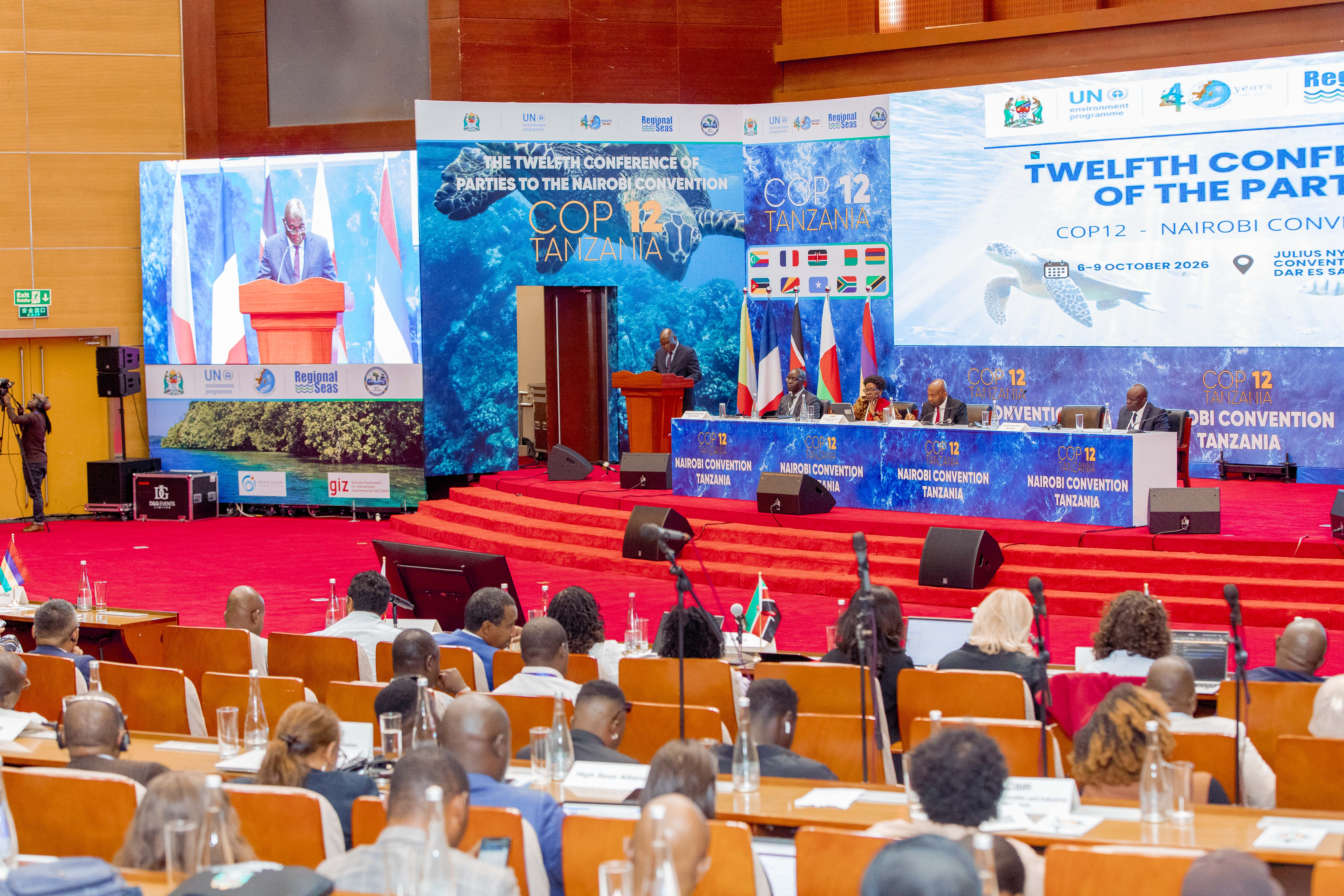
The concern was raised during the Blue Economy Business Forum held in Dar es Salaam as part of the 12th Conference of Parties to the Nairobi Convention, which is taking place from October 6 to 9, 2026.
The forum brought together government officials, researchers, private-sector players and other stakeholders to explore ways of turning the region’s marine resources into investable and sustainable businesses.
The Director General of the Zanzibar Fisheries and Marine Resources Research Institute (ZAFIRI), Dr Zachara Hamisi, said the global ocean economy is currently valued at about $2.6 trillion and could reach $3 trillion by 2030.
He said the Western Indian Ocean alone has significant untapped economic potential, with a 2017 study estimating the value of the region’s ocean economy at $13.9 billion.
“We are here to discuss how we can make that money circulate within the economies of our countries,” Dr Hamisi said, calling for greater investment in value addition instead of continued dependence on the export of raw marine products.
He said investment opportunities extend beyond conventional activities such as fishing, aquaculture and tourism to emerging areas including blue carbon, marine biotechnology and sustainable ecosystem conservation.
But identifying opportunities is only the first step, Dr Hamisi said, arguing that countries must develop projects capable of attracting financing and generating returns while protecting marine ecosystems.
That, he said, requires technology, innovation, capital and stronger business models, as well as collaboration among governments, the private sector, financial institutions, researchers and communities.
The Director of the Department of Blue Economy Development and Coordination, Ms Mondy Muhando, said the central challenge was no longer simply the availability of marine resources, but how to convert them into viable investments without degrading the ecosystems on which the economy depends.
“Our challenge is to turn what we have into investment,” she said, calling for a shift from conventional exploitation of marine resources towards business models that bring together technology, finance, institutions, communities and entrepreneurs.
Ms Muhando said the success of the blue economy should not be measured only by the volume of business generated, but also by whether economic activities can continue without exhausting the natural resources that sustain them.
She identified value addition as a key route to increasing earnings, urging businesses to explore ways of producing a wider range of products from marine resources instead of exporting raw materials.
Theuri Mwangi of the Nairobi Convention Secretariat and the United Nations Environment Programme (UNEP) said opportunities also existed in sustainable fisheries, aquaculture, blue carbon and environmentally responsible tourism.
He said countries should identify stakeholders, potential conflicts over resource use and competing interests before projects are launched, while involving communities from the early stages.
“Now is the time for the private sector to participate fully in this,” Mr Mwangi said, stressing that financing mechanisms should ensure communities that protect and use marine resources also benefit economically.
He said community participation was important not only for fair benefit-sharing but also for ensuring that investments protect the ecosystems that underpin marine economic activities.
Deputy Minister in the Vice President’s Office (Union and Environment), Mr Reuben Kwagilwa, said value addition through processing, technology, transportation and access to markets presented some of the strongest opportunities for investment.
He said fisheries, seaweed, sea cucumbers and aquaculture could generate significantly higher returns if investors moved beyond raw products and invested in processing and products targeting higher-value markets.
“Project developers need support to make projects investment-ready. Financiers need reliable revenue structures and good governance, while governments need to create an enabling and predictable business environment,” Mr Kwagilwa said.
He said blended finance, guarantees, concessional capital and public-private partnerships could help reduce investment risks and unlock projects that might otherwise struggle to secure conventional commercial financing.
For entrepreneur Sabri Ally, founder of Sabri Knows Herbs, research and innovation demonstrate the potential for marine resources to generate a wider range of commercial products.
Mr Ally said he started his marine-products business four years ago with only four products but has since expanded the portfolio to more than 100 products, including food, medicinal products and oils.
“Research and innovation have enabled me to expand to more than 100 products,” he said, adding that access to raw materials and capital remained among the major challenges facing his business.
He said there was still considerable room for entrepreneurs to identify new ideas and investment opportunities within the marine economy.
Meanwhile, Deputy Permanent Secretary in the Vice President’s Office, Dr Maduhu Kazi, said emerging areas such as renewable energy, biotechnology, value addition and marine and coastal businesses were opening new opportunities.
He said preparing projects to become investment-ready, improving access to finance and creating mechanisms to reduce investment risks would be critical to unlocking the potential of the blue economy.
The discussions point to a common challenge facing the Western Indian Ocean region: marine wealth alone does not automatically translate into economic prosperity. Unlocking its value will require countries to move from identifying resources to developing bankable projects, attracting private capital, adding value locally and ensuring that economic gains do not come at the expense of the ecosystems that sustain them.