



Dar es Salaam. The destruction of tropical forests is not only accelerating biodiversity loss and climate change, but also erasing the world’s chances of discovering future life-saving medicines worth trillions of dollars, according to a new global analysis.
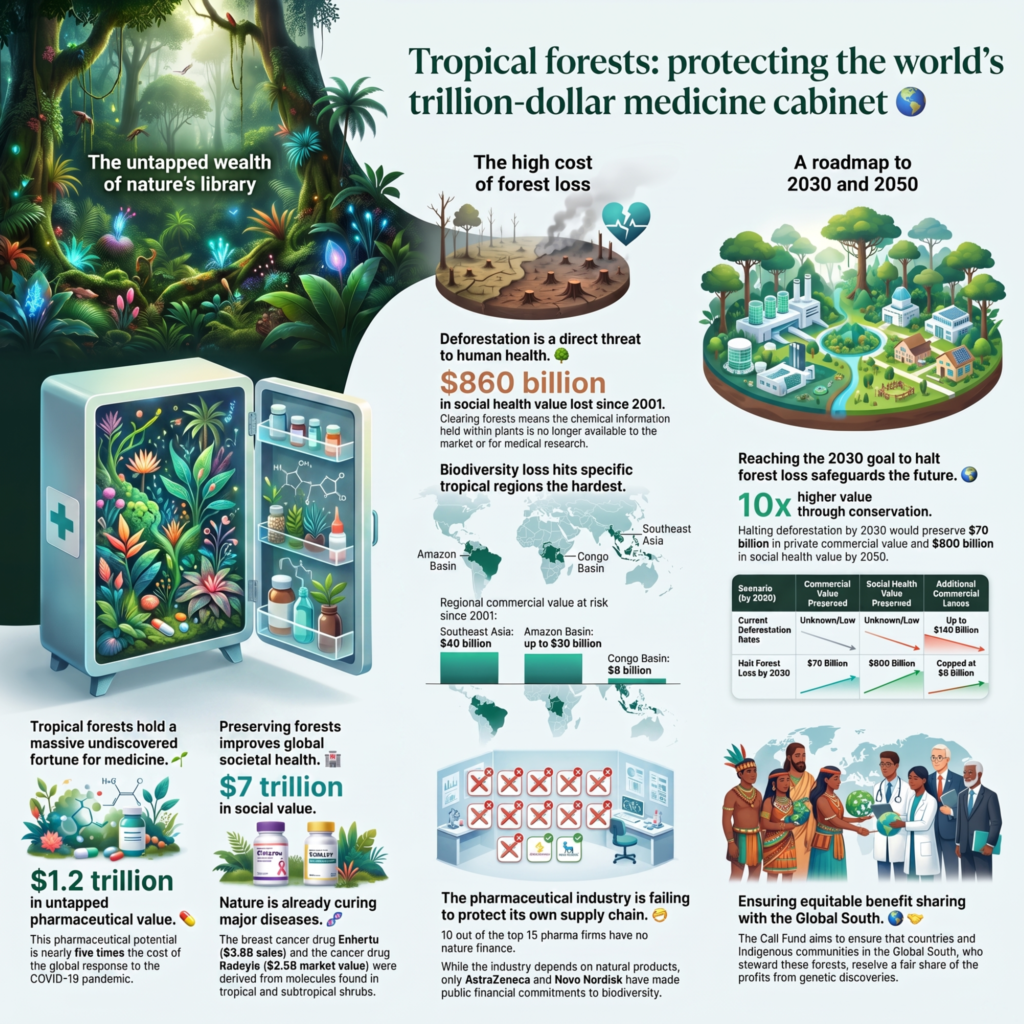
A report released by research group Zero Carbon Analytics estimates that tropical forests contain as much as $1.2 trillion in untapped commercial pharmaceutical value and an additional $7 trillion in social health benefits that could improve the lives of billions of people worldwide.
The findings come as governments prepare for crucial biodiversity negotiations, with experts urging pharmaceutical companies to invest more in conserving the ecosystems that underpin modern medicine.
According to the report, continued deforestation is steadily destroying plants, fungi and microorganisms whose unique genetic material may hold the key to future treatments for cancer, infectious diseases, antibiotic resistance and future pandemics.
Researchers estimate that tropical deforestation since 2001 may already have wiped out up to $86 billion in potential pharmaceutical value rising to $142 billion under higher estimates while society may have lost approximately $860 billion in health benefits because valuable chemical compounds disappeared before they could be studied.
Nature’s hidden laboratory
Scientists describe tropical forests as one of the planet’s richest natural laboratories.
For decades, pharmaceutical companies have relied on chemicals found in tropical plants and microorganisms to develop medicines that have transformed healthcare.
Many of today’s most successful drugs trace their origins to compounds first discovered in forests.
Among them is Enhertu, an advanced breast cancer treatment developed from a molecule first identified in the Chinese “happy tree.” The drug generated about $3.8 billion in 2024, projected to reach $13.9 billion by 2030), annually by 2030.
Another example is Kadcyla, a cancer medicine whose active compound was originally isolated from an East African shrub. The drug is expected to generate around $2.5 billion in market value in 2025.
Researchers argue that these medicines demonstrate the enormous commercial and medical value hidden within biodiversity that has yet to be explored.
Deforestation carries a growing financial cost
The report warns that if current rates of tropical forest destruction continue, pharmaceutical companies could forfeit up to $145 billion in future commercial value by 2050.
However, achieving the global commitment to halt forest loss by 2030 agreed by more than 140 countries during the UN Climate Change Conference (COP26) in Glasgow would dramatically reduce those losses.
The analysis estimates that protecting forests could limit additional commercial losses to approximately $9 billion, preserving around $79 billion in future pharmaceutical value while safeguarding nearly $800 billion in wider social health benefits.
Researchers argue that conserving forests should therefore be viewed not simply as an environmental responsibility, but as a strategic investment that strengthens medical innovation, protects supply chains and improves global public health.
Industry investment remains limited
Despite depending heavily on biodiversity, the pharmaceutical industry has invested relatively little in protecting the ecosystems that support drug discovery.
The report notes that the global pharmaceutical market was valued at approximately $1.7 trillion in 2025, yet only two of the world’s fifteen largest pharmaceutical companies have publicly announced dedicated financial commitments for biodiversity conservation.
AstraZeneca has pledged about $400 million toward biodiversity-related initiatives, while the Novo Nordisk Foundation has committed between $25 million and $30 million.
Many other companies acknowledge the importance of biodiversity in sustainability reports, but researchers say those commitments are rarely backed by measurable financial investments.
Lead author Jo Bentley-McKune said tropical forests function as highly sophisticated biochemical factories whose destruction could permanently eliminate opportunities to discover future medicines.
She noted that while pharmaceutical companies have benefited enormously from genetic resources originating in tropical regions, investment in conserving those ecosystems has not kept pace.
Global South bears the burden
The report also highlights what researchers describe as a growing imbalance between where biodiversity exists and where economic benefits are realised.
Most of the world’s biological diversity is found in tropical countries across Africa, Asia and Latin America, where Indigenous Peoples and local communities have protected forests for generations.
Yet the overwhelming share of pharmaceutical profits remains concentrated in developed economies, home to the world’s largest pharmaceutical companies.
Researchers argue that Indigenous communities, whose traditional knowledge has contributed significantly to medical discoveries, should receive fairer benefits from the commercial use of biodiversity.
More than half of the estimated pharmaceutical value identified in the report is concentrated in three tropical regions that continue to experience significant forest loss.
Southeast Asia has seen the greatest commercial value placed at risk, with as much as $40 billion potentially lost through deforestation since 2001.
The Amazon Basin has lost an estimated $12 billion to $36 billion in potential pharmaceutical value, while the Congo Basin could have forfeited up to $6 billion.
Biodiversity talks under the spotlight
The findings come as delegates gather in Kenya for the seventh meeting of the Subsidiary Body on Implementation (SBI-7) under the Convention on Biological Diversity, where governments are discussing how to implement the newly established Cali Fund.
The fund was created during the biodiversity summit in Colombia as the world’s first global financing mechanism aimed at ensuring countries and Indigenous communities receive fair compensation when companies use Digital Sequence Information (DSI)—genetic information derived from biodiversity—for research and commercial purposes.
Advances in DNA sequencing now allow pharmaceutical companies to access genetic information through digital databases rather than collecting physical samples from forests.
While this has accelerated scientific discovery, researchers argue it has also widened the gap between those who benefit financially from biodiversity and those who bear the costs of conserving it.
So far, however, the Cali Fund has attracted only $1,000 in pledges, underscoring the challenges of turning global commitments into meaningful financial support.
Technical negotiations on how companies should contribute to the fund are expected to continue during the Convention on Biological Diversity (CBD) COP17 later this year.
Researchers conclude that protecting tropical forests is increasingly becoming a public health imperative as much as an environmental one.
Beyond storing carbon and supporting wildlife, they argue, these ecosystems represent an irreplaceable genetic library whose next breakthrough could transform the treatment of diseases that continue to threaten millions of lives.