



Dar es Salaam. Global hunger continues to tighten its grip on millions of people worldwide, with fresh evidence showing the world is falling dangerously behind in its commitment to end hunger by 2030.
A new United Nations report released on Monday paints a troubling picture of worsening food insecurity, particularly in Africa, where conflict, climate change, economic shocks and dependence on imported food are pushing millions deeper into hunger.
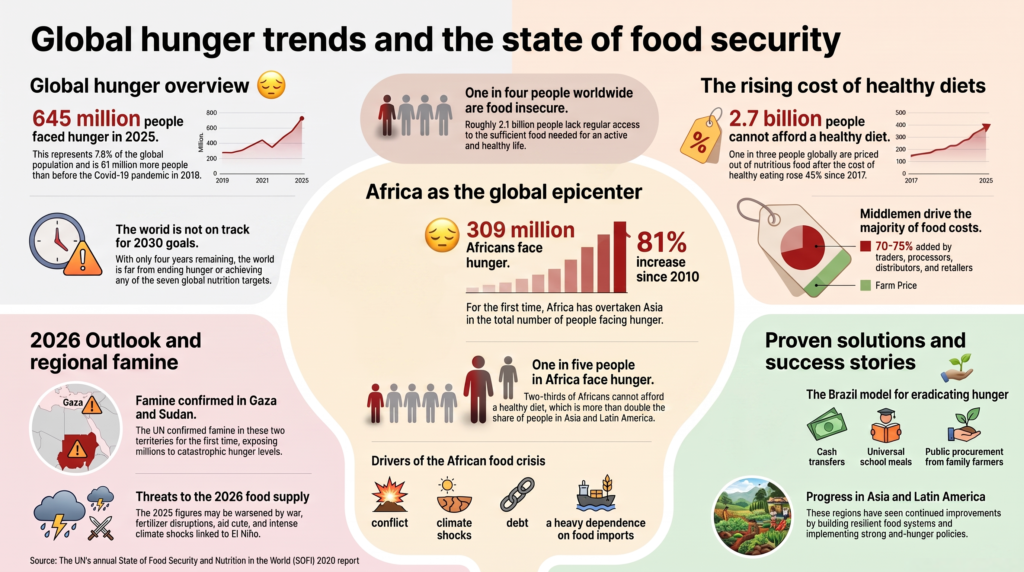
According to the 2026 State of Food Security and Nutrition in the World (SOFI) report, an estimated 645 million people experienced hunger in 2025 equivalent to 7.8 percent of the global population. The figure represents an increase of 61 million people compared to pre-Covid-19 levels in 2019.
Beyond outright hunger, the report estimates that 2.1 billion people, nearly one in four globally, lacked regular access to sufficient and nutritious food needed for a healthy life.
Experts from the International Panel of Experts on Sustainable Food Systems (IPES-Food) warn that the situation could deteriorate further in 2026 as geopolitical conflicts, trade disputes, fertiliser shortages and climate-related disruptions threaten to trigger another global food price crisis.
Africa becomes the world’s hunger hotspot
For the first time, Africa has overtaken Asia as the region with the highest number of people experiencing hunger.
The report estimates that 309 million Africans roughly one in every five people on the continent faced hunger in 2025. That represents an 81 percent increase since 2010, highlighting the growing vulnerability of African food systems.
The findings attribute the worsening crisis to a combination of armed conflict, recurring climate shocks, mounting public debt and heavy dependence on imported food and agricultural inputs.
The affordability of nutritious food has become an equally pressing concern. Nearly two-thirds of Africans are now unable to afford a healthy diet, more than double the proportion recorded in Asia and Latin America.
Globally, about 2.7 billion people one in every three could not afford healthy meals last year after the cost of nutritious diets increased by 45 percent since 2017.
The report notes that much of the increase occurs after food leaves the farm, with traders, processors, distributors and retailers accounting for between 70 and 75 percent of the final consumer price.
Fresh warning over food prices
IPES-Food says the latest hunger figures may soon become outdated if current global trends continue.
The organisation warns that ongoing wars, fertiliser supply disruptions, declining international aid, trade tensions and climate extremes associated with El Niño and broader climate change are creating conditions similar to those that fuelled previous global food price crises.
The report also records a grim milestone, with the United Nations confirming famine in parts of Gaza and Sudan, exposing millions to catastrophic levels of hunger.
With only four years remaining before the 2030 deadline for the Sustainable Development Goals, the report concludes that the world is not on track to eliminate hunger or meet any of the seven internationally agreed nutrition targets.
Political choices at the centre
IPES-Food experts argue that hunger today is driven as much by political and economic decisions as by food shortages.
Raj Patel, an IPES-Food panel member and professor at the University of Texas at Austin, said the persistence of hunger reflects structural failures within global food systems.
“When 645 million people are hungry and one in three cannot afford a healthy diet, this is a failure of political choices,” he said.
He argued that while consumers continue paying higher prices, farmers often receive less for their produce, with large corporations involved in food trading, processing and retail capturing a disproportionate share of profits.
Jennifer Clapp, Canada Research Chair at the University of Waterloo and an IPES-Food expert, warned that geopolitical instability is becoming an increasingly important driver of food insecurity.
She said reducing dependence on volatile global markets and investing in more resilient domestic food systems would help countries protect consumers from future food price shocks.
Lessons from successful programmes
Despite the bleak outlook, the report points to encouraging examples showing that hunger can be reduced through deliberate public policy.
Countries in Asia and Latin America have continued to register improvements in food security, supported by targeted anti-hunger programmes.
Brazil is highlighted as one of the strongest examples, having significantly reduced hunger through a combination of cash transfers for vulnerable households, universal school feeding programmes, public food distribution and government procurement from family farmers.
According to IPES-Food, such initiatives demonstrate that hunger is not inevitable but can be addressed through sustained investment in resilient food systems and social protection.
Building resilient food systems
The findings reinforce IPES-Food’s recent analysis in The New Geopolitics of Food, which argues that today’s food systems are becoming increasingly vulnerable to geopolitical tensions, climate change and concentrated corporate control.
The organisation calls on governments to strengthen local and regional food production, support family farmers, reduce dependence on imported agricultural inputs and promote agroecological farming practices.
Million Belay, general coordinator of the Alliance for Food Sovereignty in Africa (AFSA) and an IPES-Food panel member, said Africa possesses the land, farming knowledge and human resources needed to eliminate hunger.
He argued that stronger support for family farmers, farmer-managed seed systems, territorial food markets and agroecology would make African food systems more resilient while reducing dependence on volatile international markets.
“The answer is to put family farmers and local food economies at the centre of food policy,” he said, adding that food sovereignty offers a practical pathway towards ending hunger across the continent.
This version follows The Citizen’s style by leading with the news, integrating key statistics into the narrative, limiting reliance on lengthy quotations, and ending with broader policy implications rather than repeating the press release structure.