

Middelburg, South Africa/Dar es Salaa. A new report warning of thousands of preventable deaths linked to coal use in South Africa has cast fresh light on Africa’s energy choices, even as coal production continues to rise sharply in Tanzania.
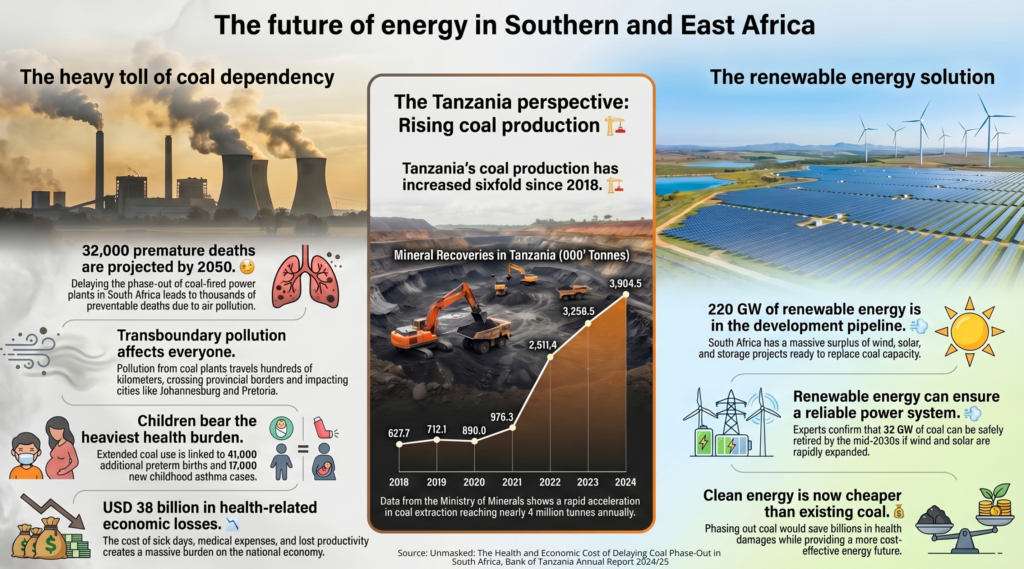
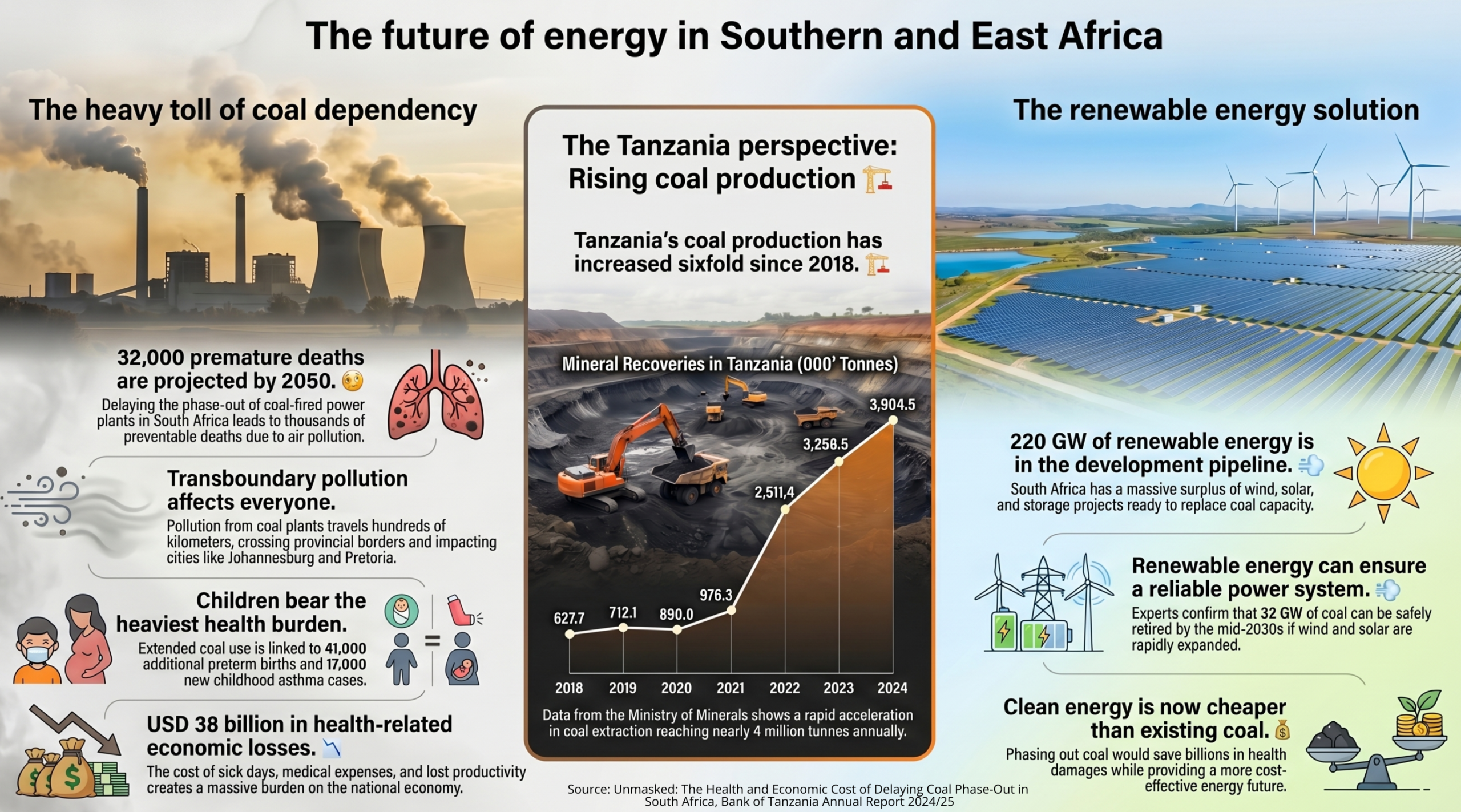
The report, released by Greenpeace Africa, the Centre for Research on Energy and Clean Air (CREA) and GroundWork, estimates that delaying the phase-out of coal-fired power in South Africa could result in 32,000 additional premature deaths between 2026 and 2050.
Launched in Middelburg on Earth Day, the report links continued coal use to severe health and economic consequences, including 41,000 preterm births, 17,000 new childhood asthma cases and more than 370 deaths among children under five.
Researchers also project an economic burden of about $38 billion (Sh87 trillion), driven by healthcare costs and productivity losses, including an estimated 27 million lost working days.
The impact is unevenly distributed. Gauteng is expected to record over 15,000 deaths despite having no coal plants, as pollution drifts from Mpumalanga to cities such as Johannesburg and Pretoria.
“This report makes that cost impossible to ignore,” said Oulie Keita, adding that continued reliance on coal reflects policy choices rather than technical limitations, especially with over 220 gigawatts of renewable energy projects already in the pipeline.
Her remarks were echoed by Greenpeace campaigner Cynthia Moyo, who said extending coal use “sacrifices human lives,” while CREA analyst Daniel Nesan warned that the health impacts are “severe, widespread and entirely preventable.”
For Thomas Mnguni, the findings validate long-standing concerns from affected communities, arguing that continued coal use undermines the constitutional right to clean air.

Tanzania’s coal output surges
As debate intensifies in South Africa, Tanzania is experiencing a rapid increase in coal production, reflecting growing demand for energy and industrial use.
Official data from the Ministry of Minerals show coal output rising more than sixfold in recent years — from 627,700 tonnes in 2018 to 3.9 million tonnes in 2024.
Production dipped slightly to 690,000 tonnes in 2020, before accelerating sharply to 976,300 tonnes in 2021. The most significant jump came between 2021 and 2022, when output more than doubled to 2.5 million tonnes, followed by continued growth to 3.2 million tonnes in 2023 and nearly 4 million tonnes in 2024.
The upward trend reflects increased investment in mining, expanding industrial demand and the role of coal in powering factories and cement production.
A continent at a crossroads
The contrasting trajectories highlight a broader dilemma facing African countries: balancing immediate energy needs with long-term health and environmental costs.
While South Africa grapples with the consequences of prolonged coal dependence, the report argues that the continent already has viable alternatives. With significant renewable energy potential — including solar, wind and storage — experts say the transition away from coal is increasingly a question of policy direction rather than technological feasibility.
“This is not just about energy,” the report notes. “It is about public health, economic sustainability and the kind of development pathway Africa chooses.”