


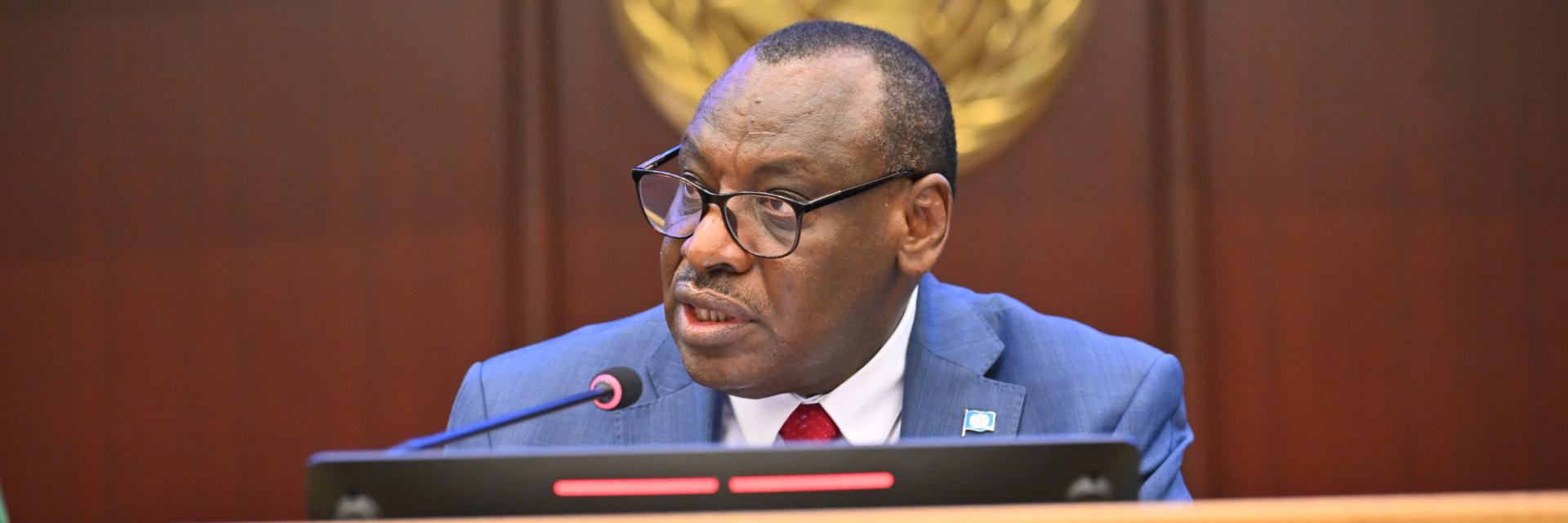
Addis Ababa. African countries must urgently move from climate commitments to credible, measurable action as the continent prepares for the next round of global negotiations, Claver Gatete, Executive Secretary of the United Nations Economic Commission for Africa, has said.
Speaking at the 7th Africa Climate Talks held alongside the 12th African Regional Forum on Sustainable Development (ARFSD-12) in Addis Ababa on April 30, Mr Gatete warned that global climate efforts are falling short at a time when impacts are accelerating.
“Our meeting is taking place at a critical time,” he said, noting that climate shocks, including floods, droughts and rising temperatures which are intensifying faster than current responses.
Citing findings from the Intergovernmental Panel on Climate Change, Mr Gatete stressed that global emissions must decline sharply within this decade to keep the 1.5°C target within reach. However, the first Global Stocktake shows the world is off track.
He said the gap between commitments and implementation is most evident in climate finance, where pledges have repeatedly fallen short, undermining trust in international cooperation.
“Africa emits less than 4 percent of global greenhouse gases, yet it is among the most vulnerable regions,” he said, pointing to growing threats to food security, water supply, infrastructure and public finances across the continent.
According to Mr Gatete, African countries require about $277 billion annually through 2030 to implement their Nationally Determined Contributions (NDCs), but currently receive only around 11 percent of that amount.
Despite these challenges, he urged a shift in narrative from vulnerability to opportunity highlighting Africa’s vast renewable energy potential, rich biodiversity and youthful population as key assets in the global climate response.
“The continent offers significant solutions,” he said, adding that Africa could play a central role in tackling global climate challenges if supported by a responsive international system.
Mr Gatete said the Africa Climate Talks provide a platform to harmonise the continent’s priorities ahead of COP31 and COP32, with Ethiopia expected to host the latter.
He warned that the global climate system is facing a credibility crisis, driven by weak enforcement of commitments under the UNFCCC transparency framework.
“COP32 must chart a new direction,” he said. “It must emphasise tangible results, not just pledges.”
He called for stronger systems to track climate finance, monitor adaptation outcomes and ensure accountability in delivery.
On financing, Mr Gatete urged reforms to ensure funds are accessible, predictable and aligned with Africa’s development needs, including increased concessional financing and changes to the global financial architecture.
He also stressed the need to prioritise adaptation, noting that it is central to Africa’s development supporting agriculture, protecting infrastructure and stabilising economies.
“Adaptation funding remains insufficient and poorly tracked,” he said, adding that even cost-effective measures such as early warning systems are not universally available.
Mr Gatete further called for climate action to be integrated into broader development strategies, linking it to industrialisation, energy access, job creation and poverty reduction.
He urged African countries to strengthen coordination in global negotiations by focusing on high-impact priorities, building alliances and investing in technical capacity.
Looking ahead, he said COP32 will be a “defining test” of whether the international community can restore trust by delivering on its commitments.
“It will test whether we can move from commitments to results,” he said, expressing confidence that Africa is ready to contribute solutions and lead a climate agenda grounded in equity and tangible outcomes.